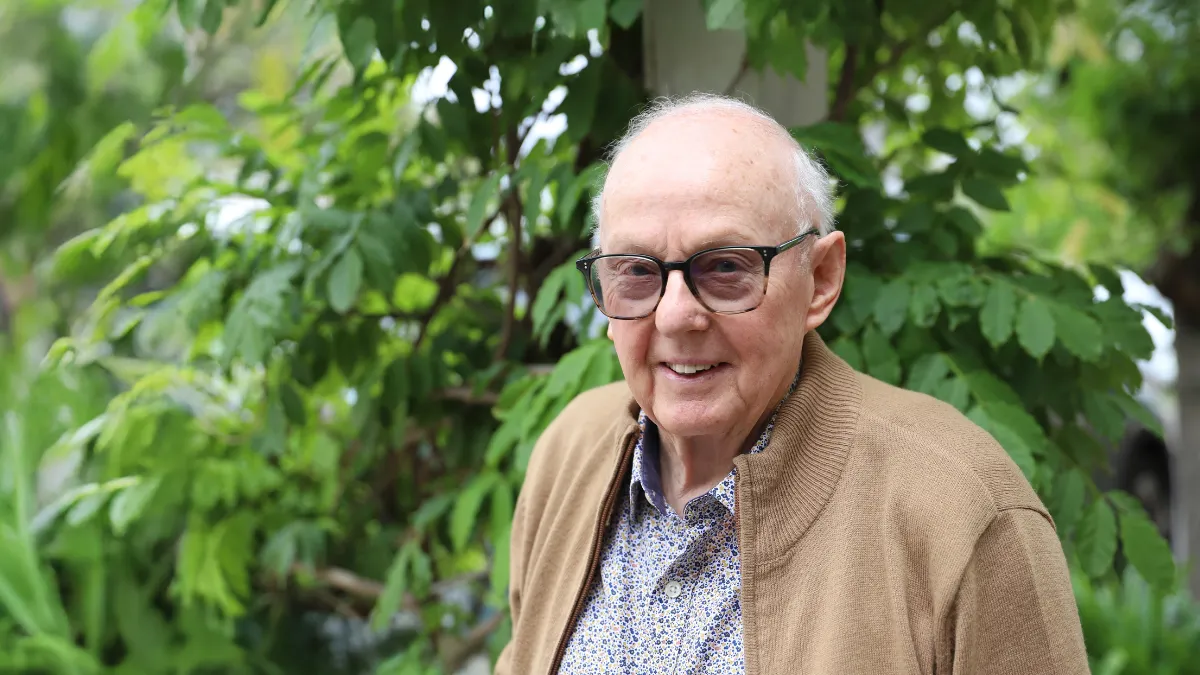
Born in Hindmarsh, in Adelaide, just prior to the start of World War II, John’s parents had to move to Sydney as his father served in the Civil Construction Corps.
In an unlucky event, John was one of 19 children who contracted polio from swimming at Cronulla Beach in Sydney on Australia Day in 1946.
“Fifty years later they found there had been a once in a hundred year tide that had brought effluent back to the beach and that it was what had caused the infection,” John said.
“I just happened to be at the beach that day.”
He spent the better part of three years in the Camperdown Children’s Hospital recovering, including the first three months in an iron lung and 12 months laying prone in bed to protect his spine.
“As a result of that the question was, ‘what was I going to do for work when I grew up with wasted limbs from the polio?’” John said.
“My father was able to get me an interview for a place in the public service in NSW with a medical examination from a very understanding doctor.
“I was only 14 and you couldn’t leave school until you were 15 but the Minister for Education made an exception because he said it would be far more beneficial for me to work in the public service than continuing at school.”
John worked for the Water Conservation and Irrigation Commission, as it was then called, starting as a Junior Records Clerk in the office at the Keepit Dam construction site in Northern NSW.
After a few years of living in staff quarters John followed his parents to Broken Hill and worked for the City Council, then followed his parents again back to Adelaide and took up a job with Chartered Accountants, Rosenthal and Lang, as an accountancy student.
John became a graduate of the 1963 Accounting cohort of UniSA’s predecessor The South Australian Institute of Technology (SAIT) and went on to become a Chartered Accountant in Public Practice, establishing a firm that today is named Grant Thornton.
At the same time, John became the co-founder of civil construction and mining publicly listed company MHL, playing an instrumental part in building the business from the ground up.
In 1992 John contracted post polio syndrome, reducing his upper right hand side mobility to similar to when he first contracted polio.
Two years of surgical intervention stopped him from continuing to be a full time CEO but his Chartered Accountancy introduced opportunities for appointments to non-executive directorships with national and international Publicly Listed Enterprises.
Again as a co-founder he became a Director of Adelaide Airport Limited, where he was the longest serving non-executive Director at the time he retired.
Always eager to enhance his skills, he also gained satisfaction from serving the CSIRO Division of Soils, the Australian Olympic Committee and the International Federation for Arbitration in Sport for Bobsleigh and Skeleton.
“The entire story could only happen because of my wife Helen, a beloved mother and educator of our children, and a fabulous homemaker who gave us not only ongoing life stability but also a physical strength I have relied on many times,” John said.
John and Helen met at the Semaphore Catholic Tennis Club.
They’ve been married for over 60 years, and have three children and four grandchildren.
A few years ago John began to find home and garden maintenance was becoming too much and decided it was the time to look into retirement living.
“By good fortune I found my way into The Waterford. The residents were immediately welcoming. The staff were, and still are, very supportive and friendly. I have never regretted the move here,” John said.
“The isolation and loneliness felt by many older people these days is non-existent at The Waterford. I have made many new friends and there is always company should you feel the need.”
John has used the onsite pool for exercise and made the most of meals that can be purchased from the Crystal Cafe at The Waterford, while he also benefits greatly from remedial massage, podiatry, physiotherapy and hydrotherapy accessed through the Support at Home program.
He is also grateful for the cleaning services available through Support at Home.